Pages

Monday, July 12, 2010

World Cup Finale


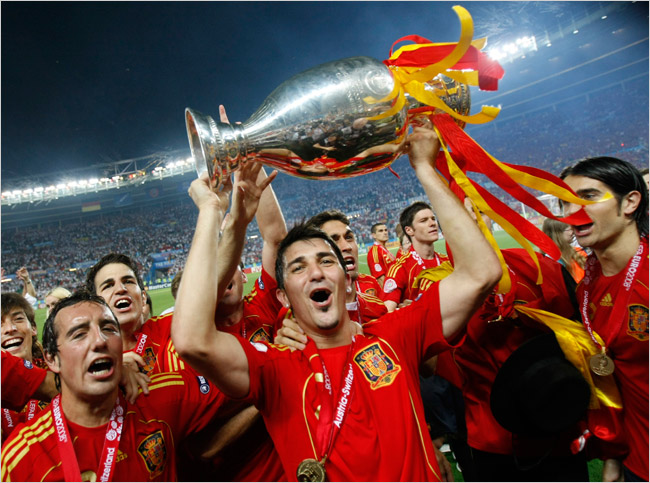
Yesterday Spain made history by winning the World Cup for the first time in their checkered sporting history. Fortunately for all the viewers the final game was most definitely the emotionally-charged event that it was expected to be. Now that the month long event is over, we should ask ourselves, ‘Was the entire event the emotionally-charged, quality tournament that should be expected from the World Cup?’ I think a variety of factors caused the cup to be less competitive than it should have been.
First of all, the lead up to the World Cup affected how the tournament played out. There were many teams hyped as good that in reality weren’t more than straw houses. For starters, the African teams showed their traditional weaknesses and did not perform. A combination of injuries and weak midfields created a disaster for the African challengers. Unfortunately, their star players (most of them star strikers, such as Eto’o and Drogba) were surrounded by players of significantly lesser-quality. The surprising country, in my opinion, was Ghana. Gyan and company made it the furthest of any African nation in the tournament, despite having the “weakest” team. Secondly, the marginal teams really did appear marginal. Sometimes there are surprises that make it through to the semi-finals, but that did not happen this year. True, some of the big favorites did not leave the group stages, but the teams that progressed far were most definitely traditional soccer powerhouses. The main straw houses (and I had predicted this at the outset of the tournament) were: England, Italy and France. England, with the exception of 4 players (Gerrard, Lampard, Terry and Rooney) is a crap team; Italy is more of a geriatric club; and France was a psychiatric ward (in between the underage prostitute drama, the lack of coaching and the anger management issues).
During the WC many FIFA decisions affected the quality of the tournament. While I think the first week of refereeing actually began well, the quality soon crashed to horrible levels. Goals were not called, linesmen were asleep, and the Jabulani ball became a super villain!
Brazil played horrendous, disastrous soccer. Because of that a major force of beautiful and competitive soccer was lacking. Dunga’s “efficient system” was shown for what it really is: a scam. Efficiency in soccer can be important in certain ways (attacking efficiently), but when defensive soccer rules, and Brazil can easily be mistaken for English soccer you know that a travesty is occurring.
Enough of the negatives. There were some highlights: Uruguay and Chile put Latin American soccer on the map. Chile played beautiful offensive soccer, and Uruguay played smart defensively with moments of offensive brilliance. Argentina, for all the drama Maradona brought out, really played beautiful soccer until the Germany game. And Paraguay showed their true potential (I will admit that Argentina is to thank for much of this- coach, players, style, etc.). Spain was weak most the tournament, but was true to their style. Germany was brilliant in my opinion. They showed what a team full of young, offensive and ambitious players can do.
In the end, I think that justice was served. Spain emerged victorious. Only an Argentine victory would have satisfied me more. Now I hope the 7 starting Roja players come back to Barca and win everything this year again!

Monday, June 21, 2010

Wimbledon Commences...

Tennis god and Swiss citizen Roger Federer was pushed to the brink by 60th-ranked Alejandro Falla of Colombia today, 5-7, 4-6, 6-4, 7-6 (1), 6-0. Federer called the siutation "uncomfortable," but realized that he has an obligation to the creators of this blog to win his seventh Wimbledon. And Roger Federer, who should have won the AP's Athlete of the Decade contest unanimously, is really fucking awesome. He's the most aggressive man in the game, totally unafraid of making mistakes. He is the most complete player in tennis history. Rafa Nadal is back on his game, as evidenced by his blistering performance at the French. I look forward to a Federer victory.

Roger Federer escapes major upset at Wimbledon

A little more perspective

I'd like to consider myself a mindful sports fan, but I am not a forgiving or forgetful one. I'm well aware that some calls will go in one's favor and some will go against. Of course the referee isn't evil. Hell, I don't consider NBA ref Tim Donaghy "evil" and he admitted to fixing games. Donaghy may have been wrong, but ultimately it was an NBA game, hardly a life or death experience, as the league's comatose crowds can attest to. I've experienced the benefits and detriments of officiating. But it still hurts a great deal to have one go against you. The pain of Argentina's 1990 and 2006 World Cup defeats are still fresh.

I also agree on the major points. I don't think Americans are too "parochial" for soccer, though. Americans have tons of distractions. No single sport in the USA comes close to rivaling the importance of soccer in, say, Argentina. I don't think ALL US sports combined have that sort of social importance. Americans do want to win and to have the world's best leagues. It is difficult to accept that the US is not the best at something, but increasingly American fans are coming around to the truth that the national team is competitive and among the top 15 or so sides in the world.

I also think that the decline of interest in baseball among those born in the US, especially in participation, is coinciding directly (this does not imply causation) with the rise of soccer. I am a fan of both sports and will save this observation for a more detailed post at a later date.

Just Anger?

Every proud fan of the American national soccer team, and truly every person I have spoken to about the World Cup, calls the decision made by the Malian referee towards the end of the last USA group stage game against Slovenia to be a fluke. Some people go as far as to claim that the decision to annul the goal was terrible, horrible, “the worst ever seen”, shit, garbage, etc. The list really goes on forever. Even the English announcers on ESPN call the decision wrong. I agree.

However, as any self-respecting soccer fan knows: soccer is masochistic and subjective. Fans suffer for 90 minutes, and well 50% of them are generally frustrated beyond belief at the end. Many times the best teams, or shall I say the teams that play best, lose. This is extremely common. My personal example is Barcelona’s home game against Inter-Milan during this year’s Champion’s League semi-finals. Barca outplayed Inter, but lost the series on aggregate scoring. I almost jumped in front a bus that day.

Knowing how emotionally painful soccer is, we must add that perhaps Americans are too parochial for soccer (Parochial Americans). I’m not so sure about that argument. As I think each culture is set in their own ways for various reasons. I generally don’t buy the anti-soccer arguments of most Americans, but I do at least understand their arguments against it. Specifically, I empathize for their frustrations with referees and decisions. No black and white, no screen replay, no bird in the sky technology, no public-pandering corporate apologies, and least of all no congressional investigations into sports. (Jajaja, the last two were just for kicks.)

At this point I do something rather controversial. I only am doing this after reading this post (Defense of Ref). If you check out the camera angles you’ll notice that there was grabbing, BUT from both teams. Sure, the Slovenians were being more aggressive, and they surely did foul American players. But I think the difference between Coulibaly and me is what spirit of soccer we take. I always take the side of forwards, and give the offside advantage and foul advantage to strikers. This is in part due to the style of soccer I enjoy, and in part to foster a more exciting game (Dunga may gasp at this opinion!). Coulibaly perhaps takes the other side, he prefers to err cautiously. Just imagine what the Slovenians would have said if their side lost due to a foul not being called in the box!

I think the USA should have been given that goal, and if anything, perhaps even a penalty. But, he isn’t some horrible ref, or an evil person dropped in that game by FIFA to sabotage the American chances of getting far in the World Cup. They would love to have the American market open to soccer!! Really! And they’re only going to get it if the Americans win! (You know how Americans will only watch it if we’re alive in the tournament.) So maybe he made a call that errs on the side of caution, and even a bad one. But soccer is subjective. And let’s not forget: The USA played like shit for the first 45 minutes. We wouldn’t even be discussing this if we would have defended and scored during the first half!

Sunday, June 20, 2010

Righteous Anger

Sports aren't fair and neither is life. We all know this to be true. But sometimes we need to get angry about something. Everyone should be angry about the call that nullified the US goal vs. Slovenia. There simply is no excuse for this officiating. It was bullshit.

The US needs to stop falling asleep at the beginning of games. Its defense was caught flatfooted on its first goal and was beaten by a splendid counterattack on the second. The team did show tremendous grit and skill in its remarkable comeback. Landon Donovan's goal was among the best of the tournament.

All in all, the US finds itself in a decent situation. As long as it beats Algeria, the US team should have nothing to worry about.

Friday, June 18, 2010

The Pain in Spain


Euro 2008 was supposed to have bridged divides among Spaniards (and Catalans) and eviscerated Spain's history of snatching defeat from the jaws of victory. Judging by their performance against Switzerland, it didn't. Del Bosque relied on a 4-1-4-1, stupidly giving undue responsibility to Sergio Busquets, who has demonstrated time and time again that he is Barçelona's worst player who starts with regularity. Mistake prone David Silva had to be removed in favor of the more creative and inspiring Jesús Navas. The press seems to think that Spain is trying to act like FC Barçelona by employing a horizontal passing game to wear down opponents and create space on the pitch. They aren't. Barçelona has a directive: use passing and movement to fill and create gaps in defenses, enabling attacking runs to be made. Spain kicked the ball around and hoped for something to happen. When Barçelona fails, the team turns around and regroups for another attack. Spain lacked the mental fortitude to intelligently attack the Swiss fortress. The Swiss showed tremendous heart and balls.

Historically, Spain has not achieved the footballing success of European counterparts Germany, Italy, and France. Moreover, despite its vast empire, Spain never reached the heights of international prestige attained by many of its counterparts during the Scientific Revolution and the Renaissance. While Italy's Mezzogiorno and Germany's East remain markedly poorer than the rest of their respective nations, neither face the kind of perpetual questions of regional and cultural cohesion (or lack thereof) that Catalonia does with Spain. I leave aside the issue of the Basque Country due to my lack of familiarity with its peculiarities.

All this brings me to my recent experiences while watching the Spain game with three Spaniards. They came from different geographies and backgrounds: Málaga in the South, Santander in the North, and the capital, Madrid. The one from Santander is a Barçelona supporter, the other two Madridistas. All three were understandably shocked and devastated by the defeat. They took it very badly. I was reminded of how I felt while watching the brutal Copa America final in 2007, in which Argentina inexplicably lost its cool despite having considerably more talented players than its Brazilian adversaries.

Almost immediately, the Spaniards roundly criticized outgoing Barçelona President Joan Laporta by saying that Laporta was celebrating Spain's loss. Laporta is outspoken in his Catalan nationalism and has expressed a desire for a Catalan national team to be independently recognized by UEFA and FIFA by 2014. A Spain loss, especially by such a talented collection of stars, might help his cause paradoxically. One must question two national teams if Spain can't win with stars from Catalonia already. After all, the majority of the squad plays for Barçelona and many are Catalans. However, Spanish defeats are likely to rile up Catalan support for going it alone.

Rather than expressing animosity toward Catalonia, however, the Spaniards were keen on noting their historical "alliance" and a desire that Catalans maintain and express their own culture. They were distraught that Catalans reject Spaniards and showed great disappointment in the perceived negative attitudes of Catalans toward Spain as a whole. They felt disrespected by Catalans, but not in a fighting manner. It was more a genuine sadness. It was fascinating to listen to such a conversation. As a Barçelona fan, I hear and read the history of animosity between the club and Real Madrid as well as between Catalonia and Madrid. But what I saw was not animosity in the slightest way. It was a profound, innately human desire to be respected and accepted by one's neighbors (and in strictly political terms, one's fellow countrymen!).

Simply put, the "Catalan question" is not black and white. Perhaps my surprise is rooted in genuine ignorance of Spanish history. Though I majored in Political Science and History and am currently working on a Master's Degree in Economics, I have NEVER, at ANY LEVEL OF SCHOOL, studied the Spanish Civil War. Nor have I received classroom instruction on Spain's post- World War II economic miracle. I doubt that this experience is unique. Spanish history seems to be very much its own. Those outside the country probably have little idea as to its complexity. I watched its results play out in dialogue.

My Spanish friends were not satisfied to vent only footballing frustrations, however. The conversation turned to the financial crisis, and the potential successors to José Luis Rodríguez Zapatero. The conservative Mariano Rajoy was mentioned, but criticized by the Madrileño for his lack of panache and personality. Other candidates were dismissed as mafiosos. What was evident was great frustration, but a burning desire for Spain to achieve its potential and be recognized as an economic and cultural leader. 

A good start would be by winning tomorrow.

Jabulani Alert

Latest news in: According to Glenn Beck, Nancy Grace and Al Gore the Jabulani Soccer Ball is responsible for the earthquake in Haiti, terrorist attacks in Afghanistan, child abductions, sex slavery, internet porn, surprising divorces and climate change. Oh, and for a couple of mishaps at the World Cup.